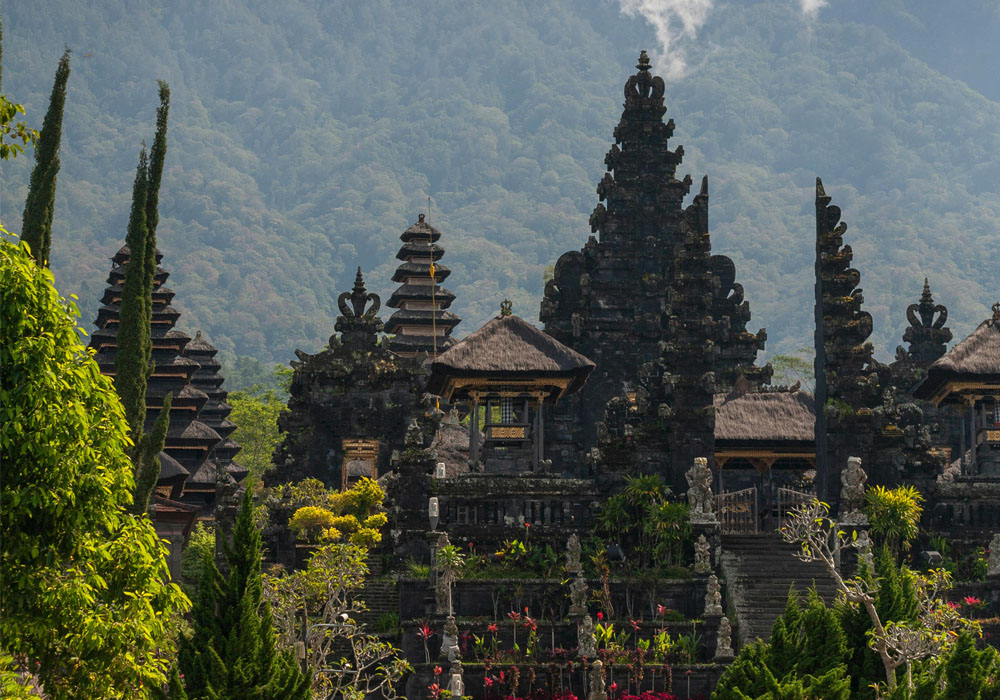
Besakih temple is not a place you simply visit. It is a place that reminds you of scale—of how small we are, and how deeply connected we can be to something greater.
Climbing Toward the Gods
I arrive in the early morning, when the mist still lingers on the slopes of Mount Agung. The air is cooler here, thinner, carrying a quiet weight that feels different from anywhere else in Bali.
In front of me rises Besakih Temple, known as the “Mother Temple” of the island. The stone steps stretch upward, leading through gates and terraces that seem to climb toward the sky.
Each step feels less like a climb and more like a transition—from the everyday world into something sacred.
The Mother Temple of Bali
Besakih is not a single temple, but a vast complex of over 80 temples spread across the slopes of Mount Agung. At its heart stands Pura Penataran Agung, the main temple, aligned directly with the mountain.
For the Balinese, Mount Agung is the most sacred place on the island—the spiritual center where the gods reside. Besakih, sitting on its slopes, becomes the bridge between humans and the divine.
This is where the island comes to pray.
A History Rooted in Devotion
The origins of Besakih Temple date back more than a thousand years. It is believed that a holy priest from Java, Dang Hyang Nirartha, played a significant role in shaping Bali’s Hindu religious structure and strengthening sacred sites across the island, including Besakih.
However, the site itself is even older, with evidence suggesting it was used for spiritual purposes long before formal temples were built.
Over centuries, kings, priests, and communities contributed to its expansion, making it the most important religious complex in Bali.
The Miracle of 1963
One of the most powerful stories connected to Besakih is from the eruption of Mount Agung in 1963. The eruption was devastating, destroying villages and taking many lives.
Yet, miraculously, the lava flow stopped just short of the main temple complex.
For the Balinese people, this was not coincidence—it was a sign of divine protection. The story is still told today as a reminder of faith and the unseen forces that shape life on the island.
FIND YOUR ACTIVITIES IN BALI
Ceremony, Color, and Community
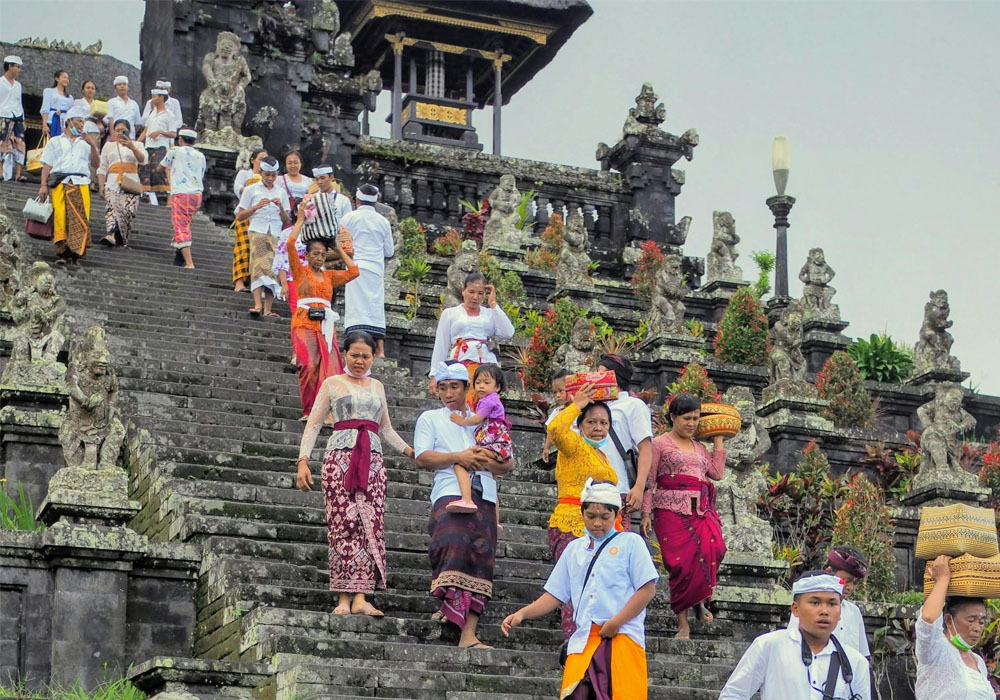
As I walk through the temple grounds, I see groups of worshippers dressed in traditional white and yellow, carrying offerings on their heads. The atmosphere is alive—not with noise, but with purpose.
Besakih is not a quiet monument. It is a living spiritual center where ceremonies take place regularly, sometimes involving entire villages.
Each temple within the complex serves a different function, connected to family lineages, clans, and aspects of the divine. This layered system reflects the complexity of Balinese Hinduism—deeply organized, yet beautifully fluid.
Harmony with the Divine
At Besakih, the philosophy of Tri Hita Karana feels especially strong. The alignment of temples, the direction of prayer, and the structure of the complex all reflect the balance between humans, nature, and the gods.
Mountains are sacred because they are closest to the heavens. By building Besakih on the slopes of Mount Agung, the Balinese express their desire to stay connected to the divine.
Best Time to Visit
The best time to visit Besakih Temple is early morning between 8:00 and 10:00 AM. The light is soft, the temperature is cooler, and the views of Mount Agung are often clearer before clouds gather.
Another meaningful time to visit is during temple ceremonies, though these can be crowded and require extra respect and proper attire.
Entrance Fee and Visitor Information
The entrance fee to Besakih Temple is usually around IDR 60,000–100,000 per person, often including:
- A sarong and sash (required for entry)
- Access to the main temple areas
- Sometimes a local guide (depending on the package)
Visitors should dress respectfully and follow temple rules. Certain inner sanctuaries are reserved for worshippers only.
How to Get There
Besakih Temple is located in East Bali, about:
- 2–2.5 hours from Ubud
- 2.5–3 hours from southern Bali
The journey takes you through traditional villages, rice fields, and mountain roads, gradually revealing the presence of Mount Agung as you get closer.
Leaving with a Sense of Reverence
As I walk back down the long staircase, I turn one last time to look at the temple rising against the mountain. The clouds have begun to gather, partially hiding the peak of Mount Agung.
It feels intentional, as if the mountain reveals itself only when it chooses.
Besakih is not a place you simply visit. It is a place that reminds you of scale—of how small we are, and how deeply connected we can be to something greater.
If Ubud teaches culture, Mount Batur teaches humility, and Banyumala teaches stillness, then Besakih teaches devotion.
And that lesson stays with you, long after you leave the mountain behind.