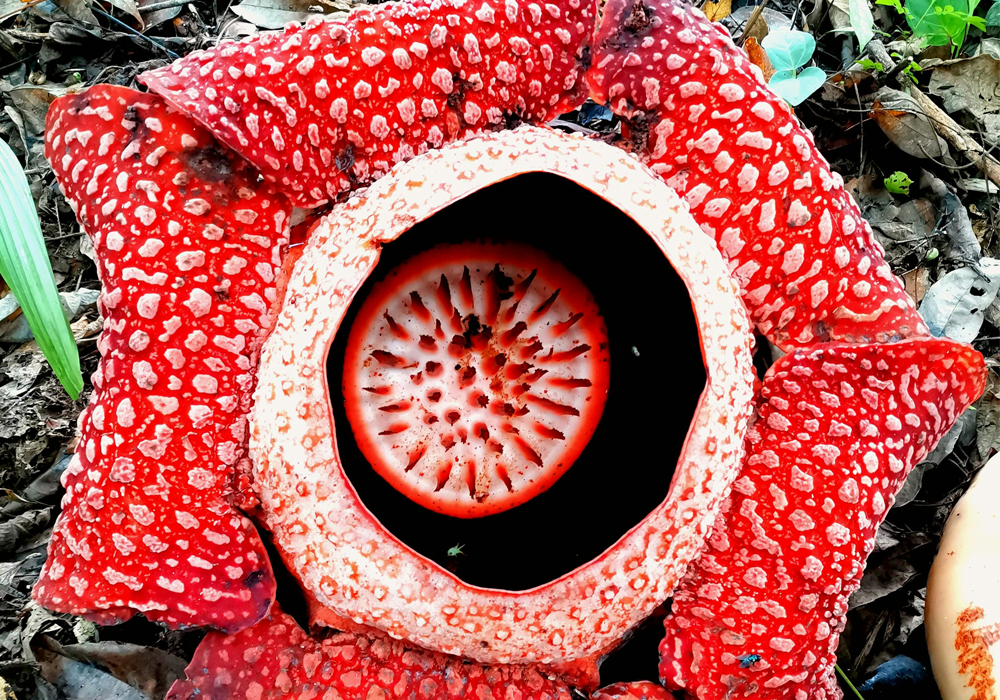
Rafflesia Arnoldii. Imagine walking deep into a steamy, emerald-green rainforest. You push past giant ferns and towering trees, the air thick with humidity and the sound of exotic birds. Suddenly, your guide stops and points to the jungle floor.
There, sitting directly on the dirt without a stem or a single leaf in sight, is something that looks like it belongs in a science fiction movie. It’s bright red, covered in strange polka-dots, and it is absolutely enormous.
Congratulations! You have just met the Rafflesia arnoldii, one of Mother Nature’s weirdest and most wonderful creations.
It is famous for two very specific things: being incredibly huge and smelling incredibly bad. But there is so much more to this fantastic flower than just its size and scent. It is a biological marvel that breaks all the rules of how a normal plant should behave.
Let’s dive into the fun and fascinating world of the Rafflesia arnoldii, the true superstar of the plant kingdom.
1. It is the Undisputed Heavyweight Champion
When we say this flower is big, we mean gigantic. The Rafflesia arnoldii currently holds the Guinness World Record for being the largest individual flower on Earth.
How big? Picture a extra-large pepperoni pizza. Now double it. A full-grown Rafflesia can stretch up to 3 feet (1 meter) across!
It isn’t just wide; it’s heavy, too. This massive bloom can weigh a whopping 24 pounds (11 kilograms). That’s about the same weight as a medium-sized dog or three bowling balls sitting on the jungle floor. It has five thick, leathery red petals covered in bumpy, lighter-colored spots that look a bit like warts. In the center, there is a deep bowl that could easily hold several liters of water.
It is truly a magnificent sight that makes regular garden flowers look tiny in comparison.
2. It’s the Ultimate “Lazy” Plant (A Parasite!)
If you drew a picture of a flower in school, you’d probably draw roots, a stem, green leaves, and petals. You’d know that plants need sunlight to make their own food through photosynthesis.
Well, the Rafflesia arnoldii cheated on that test.
This amazing flower has absolutely no roots, no stem, and no leaves. It is not green because it has no chlorophyll, meaning it cannot use sunlight to make energy. So, how does it survive?
It is a holoparasite, which is a scientific way of saying it’s a total freeloader. The Rafflesia lives entirely inside another plant. Its host is a specific type of jungle vine called the Tetrastigma, which is related to grapes. For most of its life, the Rafflesia is invisible, existing only as tiny, thread-like cells hiding inside the woody stems of the vine, stealthily stealing nutrients and water.
You wouldn’t even know it was there until it decides it’s time to put on a show.
3. Its Smelly “Superpower” is Genius
Okay, let’s talk about the smell. You have probably heard it called the “Corpse Flower.”
Yes, when it is in full bloom, the Rafflesia arnoldii emits a powerful, pungent odor that smells exactly like rotting meat. It is definitely not a flower you want in a Valentine’s Day bouquet!
But this terrible smell is actually a brilliant survival strategy. Most flowers smell sweet to attract bees and butterflies. But down on the dark jungle floor, the Rafflesia needs to attract different customers: carrion flies and beetles.
These insects love decaying things. The flower’s nasty smell, combined with its reddish, meaty appearance, tricks these bugs into thinking they’ve found a delicious dead animal. The flies buzz into the flower’s central bowl looking for a meal. Instead, they get covered in sticky pollen. When they realize there is no food and fly away to be tricked by another Rafflesia, they deliver the pollen. It’s a magnificent botanical prank!
4. Where Exactly Can You Find It?
Are you wondering if you can find one in your local park? Unfortunately, no.
The Rafflesia arnoldii is incredibly picky about where it lives. It is found exclusively in Southeast Asia. Specifically, it calls the dense, primary rainforests of Indonesia its home.
Indonesia is an archipelago of thousands of islands, but this flower is most famously found on the two massive islands of Sumatra and Borneo (the Borneo part of its range also crosses slightly into Malaysia).
It is a true island treasure. In fact, it is one of Indonesia’s three official national flowers, celebrated as the puspa langka, or “rare flower.” To see one, you have to be willing to trek into the humid, deep jungle with experienced local guides who know exactly where the host vines grow.
5. It Plays a Long Game of Hide-and-Seek
Many people ask, ” Is there a Rafflesia season? Does it bloom every spring?”
The answer is a frustrating no. The Rafflesia arnoldii does not have a set season. It can bloom in January, July, or October. It is entirely unpredictable.
Furthermore, the blooming process is agonizingly slow. When the plant finally decides to reproduce, a small, cabbage-like bud bursts out of the host vine’s bark. That bud sits on the jungle floor, slowly swelling and growing for roughly nine months. It takes almost as long as growing a human baby just to get the bud ready!
6. The “Blink and You’ll Miss It” Bloom
After waiting nine long months as a bud, the magnificent flower finally opens up to reveal its glory. You’d think something that took so long to grow would last a while, right?
Wrong. The Rafflesia arnoldii only stays in bloom for a incredibly short time—usually just 5 to 7 days.
After about a week, the glorious red petals begin to decay, turning into a black, slimy mush on the forest floor. This extreme rarity—the unpredictable timing and the very short window to see it—is what makes seeing a Rafflesia in real life such a positive, once-in-a-lifetime experience for adventurous travelers.